Safety During the Dismantling of Industrial Plants
Precision, protection and responsibility as top priorities
The dismantling of industrial plants is a highly complex process that goes far beyond simply dismantling or scrapping machines. The focus is not only on technical precision and efficiency, but above all on the safety of the employees involved, the protection of the environment and compliance with legal requirements.
Errors or negligence can have serious consequences – from accidents at work and production downtime to legal and financial consequences.
This makes it all the more important that dismantling projects are planned professionally, carried out by qualified specialists and accompanied by consistent safety measures. Safety is not an add-on, but an integral part of every industrial dismantling project.
Complex Challenges in Industrial Dismantling
Industrial plants are characterised by large dimensions, complex structures and, in some cases, hazardous working environments. Dismantling or scrapping involves numerous risks that must be identified and controlled at an early stage.
Typical challenges include:
- Hazardous materials such as oils, chemicals, coolants or asbestos-containing materials
- Heavy loads handled using cranes, excavators or hydraulic systems
- Hot and cold dismantling processes using cutting torches and separation tools
- Tight timeframes to minimise production downtime
- Limited space increasing the risk of accidents and damage
These factors clearly show that industrial dismantling requires experience, clearly defined processes and the highest safety standards.
Planning and Risk Analysis
Safe dismantling does not begin on the construction site, but in the planning phase. Before the first bolt is loosened, experts carry out a thorough risk analysis. The objective is to identify potential hazards and define appropriate safety measures.
Key planning questions include:
- Which hazardous materials are present and how can they be disposed of properly?
- Which machinery, cranes and tools are required?
- Which personal protective equipment (PPE) is necessary?
- How will the construction site be secured and access controlled?
- Which legal, occupational safety and environmental regulations apply?
Structured planning forms the basis for a safe, efficient and legally compliant dismantling process.
Professional Execution by Qualified Personnel
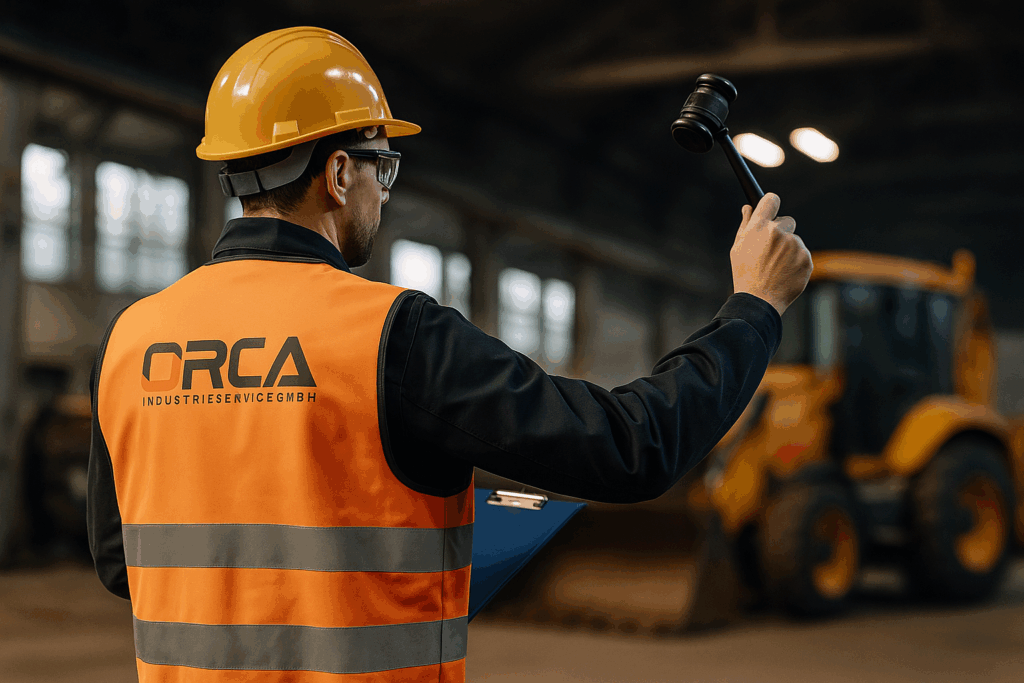
Dismantling projects may only be carried out by trained specialists, including fitters, welders, crane operators, electricians and safety experts. All work is performed according to clearly defined procedures and under continuous supervision by the project management team.
Particular focus is placed on:
- Personal protective equipment (PPE): helmets, safety goggles, gloves and respiratory protection
- Standard-compliant work processes: adherence to DGUV regulations, fire protection and environmental guidelines
- Clear communication: regular coordination, safety briefings and documentation
This minimises risks and ensures controlled and transparent project execution.
Safety Through Modern Technology
In addition to specialist expertise, modern technology plays a central role in ensuring safety during dismantling. Advanced machinery and digital tools increase precision and significantly reduce risks.
- Hydraulic lifting and lowering systems for heavy loads
- Cranes and excavators equipped with specialised attachments
- Cutting and separation tools for hot and cold dismantling
- 3D scanning and digital planning tools for precise preparation
Environmental Protection and Sustainability
Safety does not end with protecting employees. Responsible dismantling also takes ecological aspects into account. Materials are separated by type, recyclable materials are recovered and hazardous substances are disposed of in accordance with regulations.
Uncontrolled releases of oils or chemicals are consistently avoided. Through structured disposal and recycling concepts, ORCA Industrieservice actively contributes to resource conservation and sustainable industrial processes.
Conclusion
Safety is the key success factor in any industrial dismantling project. Only with clear concepts, qualified specialist personnel and modern technology can risks be effectively controlled and projects implemented efficiently.