Why 3D Scanning Is the Future of Industry
Precision, speed and transparency for confident decision-making
Industrial projects are becoming increasingly complex. Plants grow over decades, documentation is incomplete or outdated, and conversions take place during ongoing operations. This is precisely where traditional inventory surveys reach their limits.
Today, reliable digital inventory data is a prerequisite for collision-free planning, efficient assembly and disassembly processes, and audit-proof documentation.
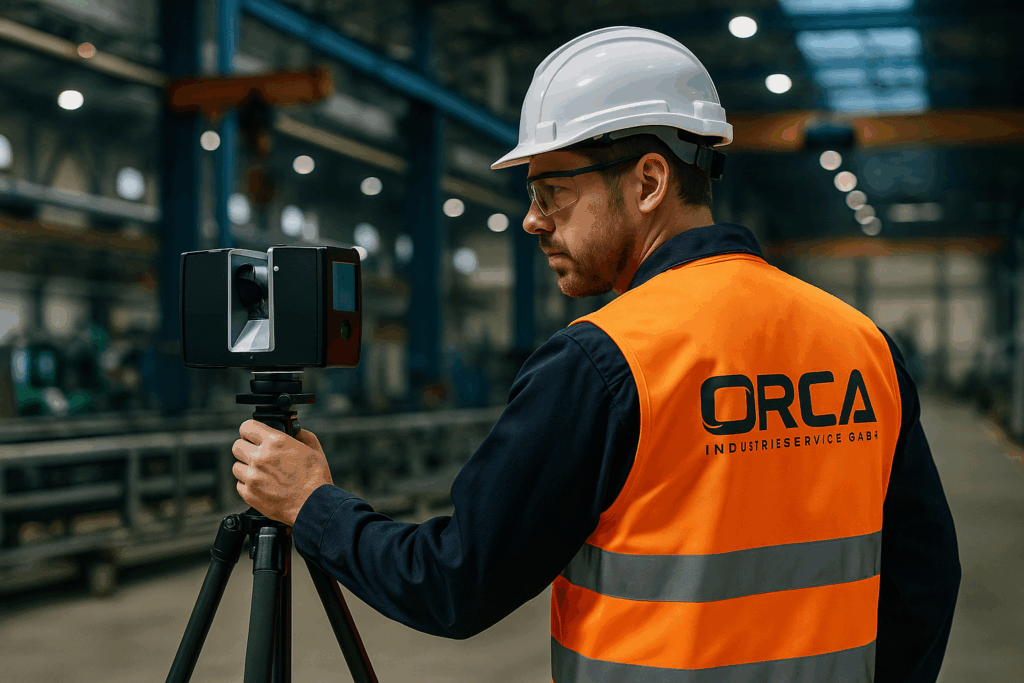
3D scanning delivers this data quickly, reliably and completely. Millimetre-precise point clouds and models derived from them create a realistic digital twin of the existing plant – the basis for informed decisions throughout the entire project life cycle.
Digital Inventory Data as the Foundation of Modern Industrial Projects
Missing or inaccurate inventory information is one of the most common causes of delays, rework and cost overruns. 3D scanning closes this gap by accurately capturing existing buildings, facilities and infrastructure – regardless of size, complexity or accessibility.
The big advantage: all relevant geometries are fully documented without unnecessarily disrupting ongoing operations. Planners, project managers and contractors work with a uniform, reliable set of data.
Technologies & Results
- Terrestrial laser scanning (TLS), mobile SLAM scanning, drone photogrammetry
- Formats: E57/LAZ (point clouds), OBJ/PLY (mesh), IFC/Revit (BIM), DWG/sections
- Deliverables: digital twin, drawings, clash detection, volumes and mass calculations
Industrial Applications
- New installation & retrofitting: Collision-free planning and precise integration of new systems
- Company relocations: Reliable inventory data for dismantling, transport and reassembly
- Dismantling & demolition: Quantity and material flow determination, safe dismantling planning
- Gutting & conversion: Precise planning during ongoing operations
- Property and site development: Inventory analysis as a decision-making basis
- QA & as-built documentation: Audit-proof evidence after project completion
This makes the digital twin the central reference model for all project participants.
Benefits
- Time savings & cost certainty through fewer planning errors and less rework
- Greater safety through reduced on-site presence and drone use in risk areas
- Maximum transparency with a single, consistent data set for all stakeholders
- Reliable planning basis for scheduling and budget decisions
- Audit-proof documentation for approvals, conversions and audits
ORCA Workflow
Scope & safety definition ➜ scan acquisition (TLS / SLAM / drone) ➜ registration & quality control ➜
analysis ➜ drawings, sections & clash detection ➜ viewer handover ➜ as-built verification
Conclusion
3D scanning reduces risks, accelerates industrial projects and creates transparency across all project phases. The digital twin becomes a reliable basis for decision-making – from the initial design to assembly and disassembly through to as-built verification.
With ORCA Industrieservice, companies use 3D scanning not as an add-on, but as a strategic tool for precision, safety and efficiency.